
Website Design & Development.
Website Design vs Website Development: What Does Your Business Need?
Website Design vs Website Development: What Does Your Business Need?
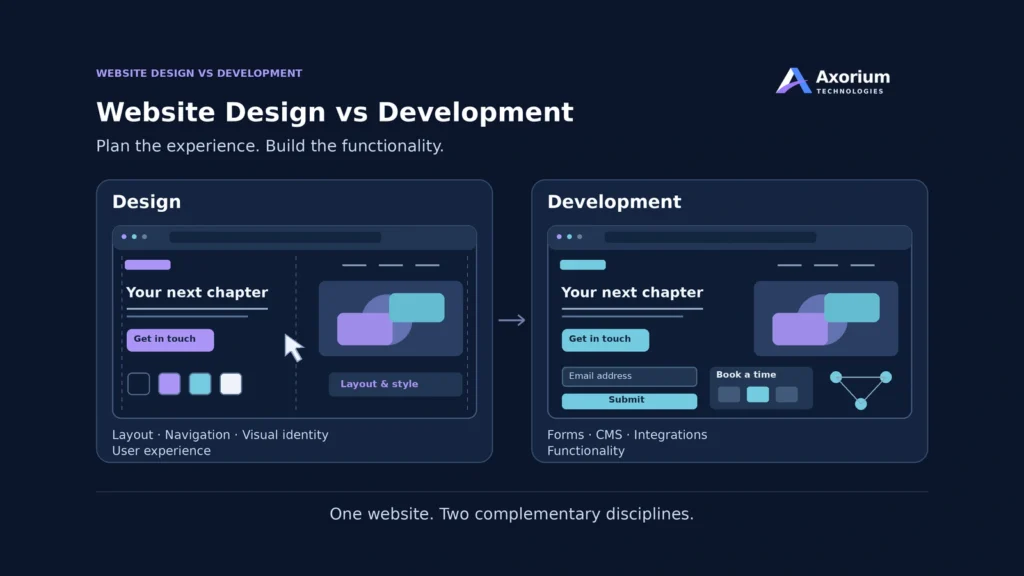
Understanding website design vs development helps you choose the right services for your next project. Design shapes how a website looks and how visitors move through it. Development turns those plans into working pages, forms and features.
Most new business websites need both. However, an existing website might need a design refresh, a functional improvement or a combination of the two.
Before requesting a quote, identify what visitors need to accomplish and what currently prevents them from doing it. This guide explains the differences and helps you prepare a clearer project brief.
Website Design vs Development: The Main Differences
Website design focuses on presentation and the visitor experience. Website development focuses on implementation and functionality.
In practice, the responsibilities often overlap, particularly when one agency handles the complete project. Therefore, ask what the service includes rather than relying on its name alone.
| Area | Website design | Website development |
|---|---|---|
| Main focus | Appearance, layout and usability | Working pages, features and integrations |
| Typical work | Page layouts, typography, navigation and visual hierarchy | Forms, CMS setup, interactive behaviour and system connections |
| Common deliverables | Wireframes, mockups and design specifications | A functioning website and configured features |
| Review questions | Is the content clear and easy to navigate? | Do the features work reliably? |
| Mobile considerations | Readable layouts and suitable controls | Implementing and testing responsive behaviour |
| Business contribution | Helps visitors understand the offer and next step | Enables visitors to complete the intended action |
Therefore, a useful website connects these responsibilities. A well-designed enquiry form still needs to submit correctly, and a working form still needs clear labels and instructions.
What Does Website Design Include?
Website design involves more than choosing colours and adding a logo. It organises information so visitors can understand your business and find what they need.
Depending on the project, design work may include:
- Planning page layouts and content hierarchy.
- Creating wireframes before detailed visual work.
- Choosing typography, colours and image treatments.
- Designing navigation and calls to action.
- Preparing desktop and mobile layouts.
- Designing forms, service cards and other interface elements.
For example, a service business might need a homepage that explains its offer, individual service pages and a clear route to request a quote.
Therefore the design should support that journey. Visitors should be able to understand what the business does, assess whether it suits their needs and take the next step.
Where Do UI and UX Fit?
User interface design, or UI, covers the elements people interact with, such as buttons, menus and forms.
User experience, or UX, considers the broader journey: how easily someone understands the website, finds information and completes a task.
For instance, choosing a button’s appearance is a UI decision. Deciding where that button belongs in the booking journey involves UX.
Both contribute to website design, although the depth of research and testing varies by project.
What Does Website Development Include?
Website development makes the approved layouts and requirements work in a browser.
The scope may include:
- Building page templates.
- Setting up a content management system.
- Implementing responsive layouts.
- Configuring enquiry forms.
- Adding booking or ecommerce features.
- Connecting approved third-party systems.
- Testing links, interactions and submissions.
- Preparing the website for launch.
For example, some development work affects what visitors see and interact with. Meanwhile, other work handles information behind the scenes, such as processing a form or updating a record.
For example, a quotation feature might display questions to the visitor, calculate an estimate and send the submitted details to your team. Each part needs clear requirements and testing.
Using WordPress or a visual page builder does not remove this implementation work. The amount of custom coding depends on the project and available tools.
When Your Business Needs Website Design
Design work may be the main priority when your website functions correctly but visitors struggle to understand or navigate it.
Common signs include:
- Important information is difficult to find.
- Pages use inconsistent layouts or styles.
- Text is hard to read on mobile.
- Calls to action are unclear.
- The website no longer reflects your brand.
- Forms ask questions in a confusing order.
For example, a business may have a working contact form but place it where visitors rarely notice it. A clearer page structure and enquiry journey could be more relevant than adding another feature.
However, low enquiry numbers alone do not prove a design problem. Traffic relevance, the offer and the information provided also need consideration.
When Your Business Needs Website Development
Development may be the priority when the website’s appearance is suitable but its features do not meet your requirements.
Examples include:
- Enquiry forms fail to deliver submissions.
- Booking steps do not work as intended.
- Staff cannot update essential content.
- A checkout or payment connection needs implementation.
- Information must be passed to another system.
- Existing features behave incorrectly on certain devices.
To begin, describe the problem through a specific action.
“Customers need to select a service and receive an estimated quote” is more useful than “We need an advanced website.”
Similarly, explain what happens after submission. Does your team need an email, a CRM record or a booking confirmation?
These details help a developer assess the work accurately.
Website Design vs Development: When You Need Both
A new website usually needs both a planned visitor experience and a working implementation.
Similarly, a substantial redesign often requires both. Changing the page structure may require new templates, while adding a feature may require changes to the interface.
Consider an appointment booking project:
- Design defines how visitors choose a service, date and time.
- Development connects the interface to availability and booking rules.
- Testing checks whether the complete journey works.
- Content explains confirmations, changes and cancellations.
Treating the project as a shared process helps prevent gaps between the approved design and the finished website.
Accessibility Requires Design and Development
In addition, accessibility should be considered throughout the project.
Design decisions include readable text, suitable contrast and clear instructions. Implementation decisions include properly labelled forms, meaningful page structure and keyboard access.
For example, a form can look attractive while remaining difficult to use without a mouse. Equally, technically correct controls can still be confusing if their labels are unclear.
W3C’s introduction to web accessibility explains how design and development help people with disabilities use websites. Include accessibility requirements in your brief and agree on how they will be evaluated.
What Should You Include in a Website Brief?
Before requesting proposals, prepare a clear brief so providers can recommend an appropriate scope.
Include the following:
- Business goal: What should the website help achieve?
- Audience: Who will use it and what information do they need?
- Main action: Should visitors enquire, book, purchase or register?
- Pages: Which pages and content are required?
- Features: What must the website do?
- Integrations: Which external tools need to connect?
- Content ownership: Who supplies text, images and product information?
- Editing needs: What should your team be able to update?
- Budget and timing: What constraints should the proposal consider?
- Ongoing support: Who handles updates and maintenance after launch?
Also, reference websites can help explain your preferences. However, identify which elements you like and why. A visual reference alone does not define the features or project scope.
Website Design vs Development: Compare Deliverables
Two proposals can use the same service name while including different work.
Check whether each quotation covers:
- Discovery and requirements planning.
- Design concepts and revision rounds.
- The number of pages or templates.
- Content preparation and migration.
- Required forms and integrations.
- Mobile and functional testing.
- Accessibility evaluation.
- Analytics configuration.
- Launch assistance and handover.
- Ongoing maintenance.
Also, clarify domain, hosting and software responsibilities. Some services involve recurring charges even when the initial website project has a one-time fee.
Agree on what completion means. For an enquiry website, that should include checking that a real submission reaches the intended recipient.
Website Design vs Development: Project Checklist
Before approving the project, confirm that:
- The website has a clear purpose.
- Design and development responsibilities are documented.
- Required pages and features are listed.
- Content responsibilities are assigned.
- Important visitor journeys have acceptance criteria.
- Mobile layouts and accessibility are considered.
- Account access and ownership are explained.
- Recurring costs and maintenance arrangements are clear.
This gives both your business and the delivery team a shared basis for reviewing the result.
Frequently Asked Questions
What is the difference between website design and development?
Website design plans the appearance, layout and visitor experience. Website development implements the pages, functionality and integrations. A complete website project commonly includes both.
Do I need a designer and a developer?
You need both skill sets when the project requires design and implementation. They may be provided by separate specialists, one professional or an agency team.
Can my existing website be redesigned without rebuilding everything?
Sometimes. Existing features may be retained while layouts and styles change. The answer depends on the current platform, condition of the website and extent of the redesign.
Does a WordPress website need development work?
Yes. Pages, forms, settings and integrations still need implementation and testing. However, available themes and plugins may reduce the amount of custom coding required.
Which service should I choose if my website is not generating enquiries?
First, investigate the cause. The issue may involve traffic, content, the offer, usability or broken functionality. Choose the scope after identifying where the visitor journey needs improvement.
Plan Your Website With Axorium Technologies
Axorium Technologies offers website design and development services for businesses building a new website or improving an existing one.
Explore our website design and website development services, or contact us to discuss your pages, features and business goals. A clear brief helps turn those requirements into a practical project scope.