
Which Back-Office Tasks Can a Business Outsource?
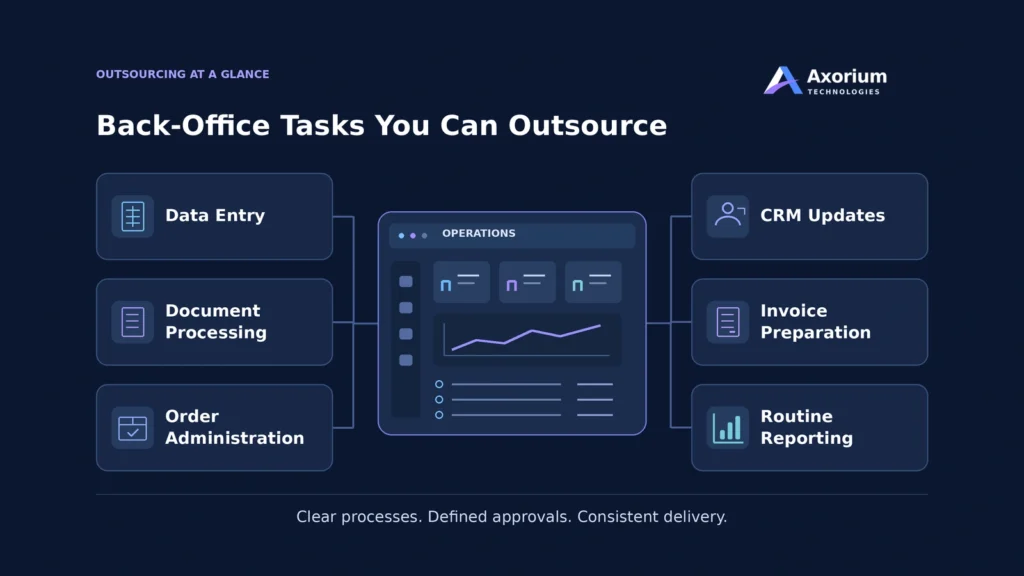
Back-office tasks such as data entry, document processing, order administration and routine reporting can often be outsourced. The best starting point is work that follows clear instructions, produces a measurable result and has defined approval boundaries.
However, delegating a task does not mean handing over every decision associated with it. For example, an external team can prepare an invoice for review while your business retains responsibility for approving it.
This guide explains which activities you can consider outsourcing, how to assess their suitability and which decisions should remain with your internal team.
What Are Back-Office Tasks?
Back-office tasks support the internal operations of a business. They help keep records accurate, documents organised and workflows moving.
Unlike frontline customer service, this work usually takes place behind the scenes. Examples include updating customer records, checking order details, organising documents and preparing operational reports.
Some activities overlap with customer support. Updating a customer’s account after a conversation, for instance, involves administrative work even though the request began through a support channel.
The important question is whether the work has a clear process that another team can follow reliably.
1. Back-Office Tasks: Data Entry and Record Maintenance
Data entry is a practical starting point when your business regularly receives information that needs to be entered into a system.
Tasks might include:
- Entering details from forms into a database.
- Updating customer and supplier records.
- Adding or correcting product information.
- Transferring information between approved systems.
- Identifying duplicate or incomplete entries.
- Checking records against source documents.
Before delegating this work, define the required fields, formatting rules and source of truth. Otherwise, different agents may interpret the same information differently.
For example, an external team could enter new customer details into your CRM and flag missing information. Your internal team would then resolve any conflicting records or uncertain account changes.
2. Document Processing and Organisation
Businesses often spend considerable time sorting, checking and filing documents.
An external team can help with:
- Naming and organising digital files.
- Classifying documents by type.
- Checking whether required documents are present.
- Extracting information into an approved template.
- Preparing document packs for internal review.
- Recording the status of submitted paperwork.
However, completeness checks should be distinguished from specialist approval.
A team can confirm that an application includes the required attachments. That does not necessarily mean it can determine whether the application meets legal, financial or technical requirements.
Provide a checklist and a clear route for exceptions.
3. Back-Office Tasks: Order Processing and Administration
Routine order administration can be outsourced when your business has documented fulfilment procedures.
Suitable activities may include:
- Entering orders into an approved system.
- Checking that order details are complete.
- Updating processing and fulfilment statuses.
- Preparing internal order summaries.
- Flagging missing delivery information.
- Passing exceptions to the appropriate person.
For example, an external team could identify an order with an incomplete address and request clarification through an approved process.
Meanwhile, your business could retain authority over unusual discounts, order cancellations and changes that affect payment or fulfilment commitments.
Document these boundaries before the team begins handling live orders.
4. CRM Administration and Sales Support
A CRM becomes less useful when records are incomplete or outdated. Routine maintenance can help your sales team work with clearer information.
Tasks to consider include:
- Updating contact and company details.
- Recording sales activities.
- Maintaining lead statuses.
- Assigning enquiries according to agreed rules.
- Preparing follow-up lists.
- Identifying records that need attention.
Nevertheless, administrative support should not be confused with sales judgement.
An external team can organise a lead list using your criteria. Decisions about pricing, contract terms and major account commitments can remain with your sales team.
Also, define how staff should handle uncertain information. Guessing a lead status can create more work than leaving it flagged for review.
5. Invoice Preparation and Finance Administration
Some finance-related administration can be delegated, provided the scope and review process are clear.
Examples include:
- Entering invoice details.
- Preparing draft invoices from approved information.
- Organising receipts and supporting documents.
- Matching references against internal records.
- Maintaining payment-status trackers.
- Preparing lists of discrepancies for review.
However, these activities are different from approving payments, providing accounting advice or making tax decisions.
For instance, a support team could prepare an invoice using an agreed price list. An authorised person within your business would check and approve it before issue.
Keep payment authority and specialist financial decisions with appropriately qualified or authorised people.
6. Routine Reporting and Spreadsheet Updates
Reporting preparation is another area where a defined process can help.
An external team can:
- Update operational spreadsheets.
- Consolidate information from approved sources.
- Prepare weekly workload summaries.
- Record outstanding tasks and exceptions.
- Populate standard reporting templates.
- Flag missing or inconsistent figures.
First, agree on how each measure is calculated. A report can look accurate while using the wrong definition.
For example, “completed orders” might mean orders entered, dispatched or delivered. Your reporting instructions should specify which event counts.
The external team can prepare the information, while your managers interpret the results and decide what action to take.
7. Product Catalogue and Website Administration
For businesses managing online catalogues, repetitive content administration may also be suitable.
Possible tasks include:
- Uploading approved product descriptions.
- Entering product specifications.
- Organising categories.
- Adding approved images.
- Checking listings for missing information.
- Updating content from an authorised change list.
Set access permissions according to the work required. Someone updating product descriptions may not need permission to change payment settings or install software.
Similarly, price changes and publication of sensitive content should follow an approval process.
Which Back-Office Tasks Should You Outsource First?
Begin with a task that is frequent, well documented and straightforward to review.
Use the following comparison to assess a potential starting point:
| Task characteristic | More suitable for an initial pilot | Needs more preparation |
|---|---|---|
| Instructions | Clear steps and examples | Depends on unwritten knowledge |
| Inputs | Consistent forms or records | Incomplete or conflicting information |
| Decisions | Defined rules | Frequent judgement calls |
| Access | Limited system permissions | Broad or sensitive access |
| Quality checks | Results can be sampled easily | Errors are difficult to detect |
| Exceptions | Clear escalation contact | No agreed owner |
A simple task with unclear instructions can still be difficult to outsource. Therefore, improve the process before expecting another team to deliver it consistently.
Keep These Decisions Under Internal Control
Your business should define which responsibilities remain with authorised internal staff or specialist advisers.
Depending on the activity, these may include:
- Approving payments and refund exceptions.
- Authorising significant pricing changes.
- Making legal, tax or accounting decisions.
- Approving contracts and commercial commitments.
- Deciding how to handle serious complaints.
- Granting access to sensitive systems.
- Changing operational policies.
The aim is to give the external team enough authority to complete its work while keeping important decisions accountable.
Before sharing business records with an external team, agree on how information will be accessed, stored and protected. For further reading, see NIST’s guidance on securing business data and devices.
How to Hand Over Back-Office Tasks
Choose one workflow and document it from start to finish.
For each task, specify:
- Input: What information or document starts the work?
- Checks: What must the team verify?
- Action: Which steps should it complete?
- Exception: When should it stop and ask for help?
- Output: What does a completed task look like?
- Review: Who checks quality and receives the report?
Next, test the instructions using sample cases. Include incomplete records and unusual situations, rather than only straightforward examples.
After that, run a limited pilot and review the results. Track accuracy, rework, turnaround time and unresolved exceptions before expanding the scope.
Frequently Asked Questions
Which back-office tasks can a small business outsource?
A small business can consider outsourcing data entry, document organisation, CRM updates, order administration and routine reporting. Start with a manageable scope that has clear instructions and an internal owner.
Is back-office outsourcing the same as BPO?
Back-office outsourcing refers to delegating internal administrative and operational work. BPO, or business process outsourcing, is a broader term that can also include customer-facing activities such as customer support.
Can an external team work in our existing systems?
It can, where your systems and access policies allow it. Use individual accounts, appropriate permissions and a documented process for granting and removing access.
How do we check the quality of outsourced work?
Define completion standards, review samples and record errors or rework. Also, check whether the team follows escalation rules when information is missing or a decision needs approval.
Should we outsource all administrative work together?
Starting with one workflow is often easier to manage. It lets you test instructions, communication and quality before adding more responsibilities.
Explore Back-Office Support for Your Business
Axorium Technologies offers back-office support for businesses seeking help with routine administrative and operational work.
Explore our back-office support services or contact us to discuss the tasks you need help managing. A clear scope can help identify what to delegate, which approvals to retain and how to organise the handover.