
Customer Support or Outsourcing
In-House vs Outsourced Customer Support: What to Compare
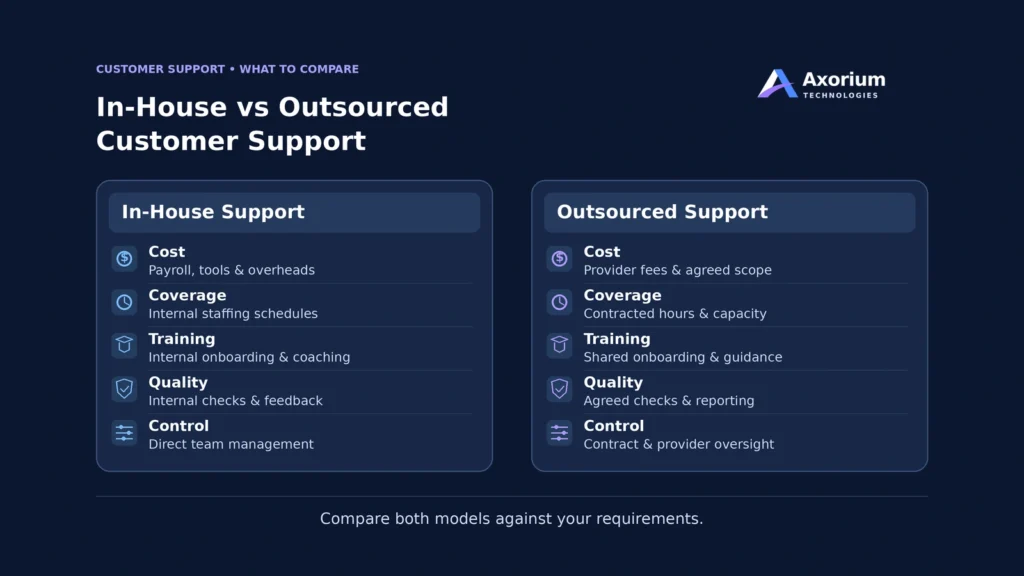
In-House vs Outsourced Customer Support: What to Compare
Comparing in-house vs outsourced customer support starts with your workload, coverage requirements and the complexity of customer enquiries. An internal team gives you direct responsibility for hiring and daily management. An outsourced team handles an agreed scope through an external provider.
Neither approach is automatically cheaper or better. The right choice depends on how each arrangement would serve your customers and what your business can manage effectively.
This guide explains the main differences and provides a practical framework for comparing both options.
In-House vs Outsourced Customer Support: The Main Differences
In-house customer support is delivered by employees your business recruits, trains and manages. Outsourced customer support is delivered by an external team working within an agreed scope, using your instructions and approval rules.
Some businesses combine both approaches. For example, an internal team might handle complex complaints while a provider manages routine email enquiries.
| Area | In-house support | Outsourced support |
|---|---|---|
| Recruitment | Your business hires and replaces staff | Provider handles recruitment within the agreement |
| Daily supervision | Managed internally | Managed by the provider, with client oversight |
| Product knowledge | Developed through internal training and involvement | Depends on onboarding, documentation and updates |
| Coverage | Depends on your staffing and schedules | Depends on contracted hours and available staffing |
| Tools | Selected and maintained by your business | Responsibilities vary by agreement |
| Capacity changes | May require hiring or schedule changes | May be available within agreed notice and capacity limits |
| Quality management | Your business designs and runs reviews | Provider reviews work against agreed standards |
| Approval decisions | Remain within your business | Follow documented authority and escalation boundaries |
Use this comparison as a starting point. Actual responsibilities should be confirmed in the staffing plan or provider agreement.
1. In-House vs Outsourced Customer Support: Costs
A fair comparison should cover the same channels, working hours and expected workload.
For an internal team, include more than salaries. Depending on your arrangements, costs may include recruitment, employment benefits, equipment, software, training, supervision and absence cover.
For outsourcing, check the complete quotation. Ask whether it includes onboarding, tools, quality reviews, account management and additional coverage.
Also, consider the internal time you will still need to contribute. Outsourcing does not remove the need to answer questions, approve exceptions and maintain accurate policies.
A useful comparison is:
In-house cost: staffing + recruitment + tools + training + management + coverage.
Outsourced cost: provider fees + setup + extras + retained internal management.
Calculate both over the same period. Separating initial setup costs from ongoing expenses can make the comparison clearer.
For more detail on provider pricing, read our guide to outsourced customer support costs.
2. Check Whether Coverage Matches Customer Demand
Review when customers actually contact your business before deciding how to staff support.
An internal team may provide suitable coverage during your regular business hours. However, extending availability could require different shifts, additional recruitment or weekend arrangements.
A provider may offer broader coverage, but confirm exactly what is included. The availability of an outsourcing service does not mean your package includes continuous support.
Ask:
- Which hours and time zones are covered?
- What happens during holidays and staff absences?
- How are conversations handed over between shifts?
- Who handles urgent enquiries outside the agreed hours?
- How much notice is needed to change coverage?
For example, a business receiving most enquiries during weekday afternoons may benefit more from stronger peak-hour staffing than from overnight availability.
3. Assess Product Knowledge and Training
Your support team needs to understand your products, policies and customers.
Internal employees may have easier access to colleagues and wider business discussions. Nevertheless, they still need structured training and accurate reference material.
An outsourced team needs the same foundations, plus a reliable way to receive updates from your business.
Compare how each arrangement would handle:
- Initial product and policy training.
- Practice conversations and supervised work.
- Changes to prices, features or procedures.
- New product launches.
- Knowledge gaps identified through quality reviews.
Complex products may require a longer learning period. Therefore, assess the training plan rather than assuming either team will be ready immediately.
Assign an internal owner to keep support information current in both models.
4. In-House vs Outsourced Customer Support: Quality
Fast replies are useful when they are accurate and help resolve the customer’s issue.
Both internal and external teams need clear standards for communication, troubleshooting and escalation. Without these, performance can vary even when agents meet their response targets.
Consider measures such as:
- First response time.
- Resolution time.
- Customer satisfaction feedback.
- Accuracy of information provided.
- Appropriate escalation.
- Unresolved enquiry backlog.
- Repeated contacts about the same issue.
Then ask who reviews conversations, how feedback reaches agents and what happens when the same problem continues.
For example, a short response time may hide poor service if customers repeatedly need to explain their issue to different people.
5. Decide Which Responsibilities You Need to Control
An internal team gives you direct management authority. However, effective control still depends on clear responsibilities and good supervision.
With an outsourced team, control is exercised through the scope, access permissions, reporting and approval rules.
Document which actions agents can take independently and which require permission. These boundaries might cover:
- Refund exceptions.
- Account changes.
- Unusual discounts.
- Sensitive complaints.
- Contract commitments.
- Changes to customer-facing policies.
Routine work can be delegated while important decisions remain with your business.
Before either team receives customer information, define access and handling requirements. NIST’s guidance on securing business data and devices provides further resources on protecting business information.
6. Assess How Each Model Handles Workload Changes
Support demand can change with promotions, seasonal activity, service problems or business growth.
An internal team may need overtime, revised schedules or additional hiring to manage a sustained increase. Meanwhile, a provider may be able to adjust capacity, depending on its staffing and contractual commitments.
Ask about:
- Notice periods for adding capacity.
- Minimum staffing commitments.
- Training requirements for additional agents.
- Charges for extra hours or volume.
- Limits on reducing the scope.
- Plans for unexpected demand.
Also, review how you would maintain quality during a busy period. Adding people helps only when they have the knowledge and supervision needed to do the work.
7. Consider Management Time and Continuity
Running an internal support team involves scheduling, coaching, recruitment and performance management.
An outsourcing provider may take responsibility for much of this daily work. Your business still needs an accountable person to manage the relationship and resolve decisions.
Consider how each model would respond if a trained agent left or a supervisor became unavailable.
Useful questions include:
- Is knowledge documented or held by one person?
- Who trains replacement staff?
- How is unfinished work handed over?
- Who can step in when the main contact is absent?
- How would you transfer the work if the arrangement ended?
A practical continuity plan matters in both approaches.
When In-House Support May Be a Better Fit
An internal team may suit your business when enquiries require frequent collaboration with product specialists or involve substantial judgement.
It may also be appropriate when you already have capable staff, suitable coverage and enough management capacity to maintain service quality.
However, check whether the team can absorb the workload without affecting other responsibilities. Employees answering support enquiries alongside unrelated work may struggle during busy periods.
When Outsourced Support May Be a Better Fit
Outsourcing may suit a business that needs help with a clearly defined workload, additional coverage or routine enquiries.
It can also be worth considering when recruitment and daily staffing management are taking time away from other priorities.
The arrangement still needs accurate instructions, suitable access and a clear internal contact. A provider cannot reliably follow policies that have not been explained.
Before committing, use a controlled pilot to assess communication, accuracy and escalation.
Could a Hybrid Approach Work?
A hybrid approach combines internal and external support responsibilities.
For example:
- An external team manages routine email and chat enquiries.
- Internal specialists handle complex technical issues.
- Your business approves exceptional refunds.
- Both teams use the same knowledge base and handover process.
This can provide flexibility, but only if responsibilities are clear. Otherwise, customers may be passed between teams without anyone owning the resolution.
Agree on who handles each enquiry type and who remains responsible when a case is escalated.
In-House vs Outsourced Customer Support: A Decision Checklist
Before choosing an approach, confirm:
- Your expected enquiry volume and busiest periods.
- The channels and coverage hours you need.
- The complexity of common customer issues.
- The full cost of equivalent service arrangements.
- Who will train, supervise and review the team.
- Which decisions need internal approval.
- How customer information will be handled.
- How staffing changes and service interruptions will be managed.
Choose the arrangement that meets these requirements with a workload your business can sustain.
Frequently Asked Questions
Is outsourced customer support cheaper than in-house support?
It can be, but the result depends on staffing, coverage, pricing and the support required. Compare the full cost of equivalent arrangements, including tools, training, supervision and retained internal management.
Does in-house support always provide better quality?
No. Quality depends on recruitment, training, accurate information, supervision and review. Both models can perform well when these foundations are in place.
Can an outsourced team use our existing helpdesk?
It may be able to, depending on the platform and access arrangements. Confirm account permissions, licensing costs and responsibility for managing access before launch.
Can we keep complex enquiries in-house?
Yes. You can outsource routine enquiries while retaining specialist work and approval decisions internally. Define the handover process so customers receive consistent support.
How should we test an outsourcing provider?
Start with a limited scope and agreed quality standards. Review sample conversations, escalation decisions and reporting before expanding the engagement.
Discuss Your Customer Support Options
Axorium Technologies offers customer support outsourcing for businesses seeking help with customer enquiries and service operations.
Explore our customer support services or read our practical customer support outsourcing checklist. If you are comparing delivery options, contact us to discuss your workload, coverage needs and approval requirements.